
Transducers
Transducers
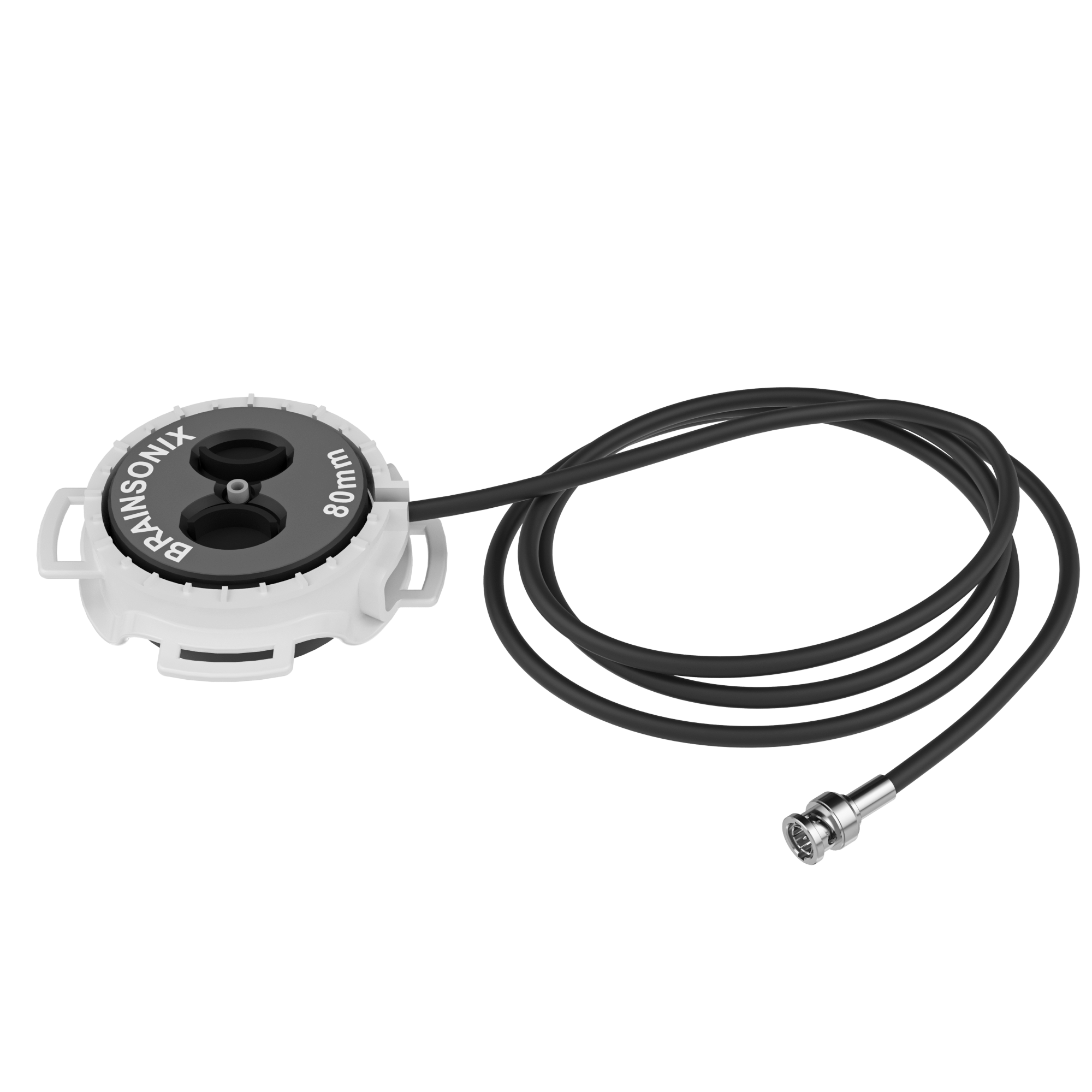
Our transducers are the critical components that convert electrical signals from the console into ultrasound waves and focus them into the brain. BrainSonix transducers are single-element, air-backed spherically focused ultrasound emitters. They have a 61 mm aperture diameter and are engineered to operate at our chosen ultrasound frequency (~650 kHz) with high efficiency. We offer transducers in multiple focal lengths – approximately 35 mm, 55 mm, 65 mm, and 80 mm – which correspond to the depth at which the ultrasound waves converge into a focus. By selecting a transducer with an appropriate focal length, users can target regions at different depths in the brain: shorter focal lengths for shallower targets (e.g. cortical areas or basal ganglia near the surface) and longer focal lengths for deep targets (e.g. thalamus, amygdala, hippocampus near the center of the brain). All transducers produce a tight focal zone on the order of only a few millimeters in size, enabling very specific targeting.
Each transducer is built with a slightly convex front face made of an impedance-matching material, which helps transmit the ultrasound energy efficiently from the transducer into the human head (minimizing reflections at the interface). The back of the transducer is air-backed to reflect sound forward and enhance focus. They are also equipped with internal fiducial markers (visible via MRI) to assist with image-guided targeting – when scanning a subject with the transducer in place, the markers show up on the MRI, indicating exactly where the device is pointing. This is extremely helpful for aligning the focus on a specific brain region under image guidance.
Our transducers come with a custom-designed head holder (headset) that secures the transducer against the patient’s head, typically over the temporal bone area (side of the head) which is a convenient acoustic window for reaching many brain regions. The holder has an adjustable strap to fit snugly and features a clip-in mechanism for the transducer. It allows both linear and angular adjustments so the transducer can be moved a bit in the X-Y plane and tilted to aim the focus precisely at the desired target. There are discrete angled grooves (0°, 2.5°, 5°) that make it easy to reproducibly set a certain angle of incidence for the ultrasound beam, and the coupling pads (described below) can be selected to match these angles. The holder is designed to maintain the transducer firmly in place during a session (important since even a few millimeters of shift could move the focus off target), while also being quickly removable or adjustable between sessions.
Calibration & identification: Each transducer is individually calibrated and tagged with a serial number that the console recognizes. The system software will prompt the user to confirm the transducer ID when starting a session, and it loads that transducer’s specific calibration file to ensure accurate output. This means if you swap to a different transducer (say, a different focal length), the system automatically adjusts for that unit’s acoustic output characteristics. Our calibration process and file system guarantee that every transducer–console pair produces the intended ultrasound intensity within a tight tolerance, ensuring experimental reproducibility and safety. If a transducer is ever re-conditioned or repaired, it is recalibrated and its file updated. The console will also alert the user if a mismatch or error in transducer connection is detected. In summary, our focused transducers – in concert with the holder and console – deliver the ultrasound beam to the brain target with high precision and reliability, forming the core of the LIFUP technology.